Welcome to Dong guan Hecon Electronics Co., ltd official website


Blog
Connectors & Cable Assemblies Manufacturer
1x4Port Shielded RJ45 Modular Jack Right Angle Without LED - Product Introduction
Release time:
2025-05-06
Introduction to RJ45 Connector
1.RJ45 connectors are widely used in:
RJ45 connectors are commonly used to connect computers, switches, routers, modems, IP phones, webcams, Internet of Things devices and other network devices to transmit data. They can also be used to connect different types of network cables, such as network cables, optical fiber cables, and twisted pairs. By connecting RJ45 connectors, different types of networks such as local area networks (LAN) and wide area networks (WAN) can be established.
Why choose us:
HECON can produce many types of RJ45 connectors at an affordable price, low MOQ, high quality, and can be delivered as soon as 2 days after confirming an order.
RJ45 Connectors: An Essential Networking Component
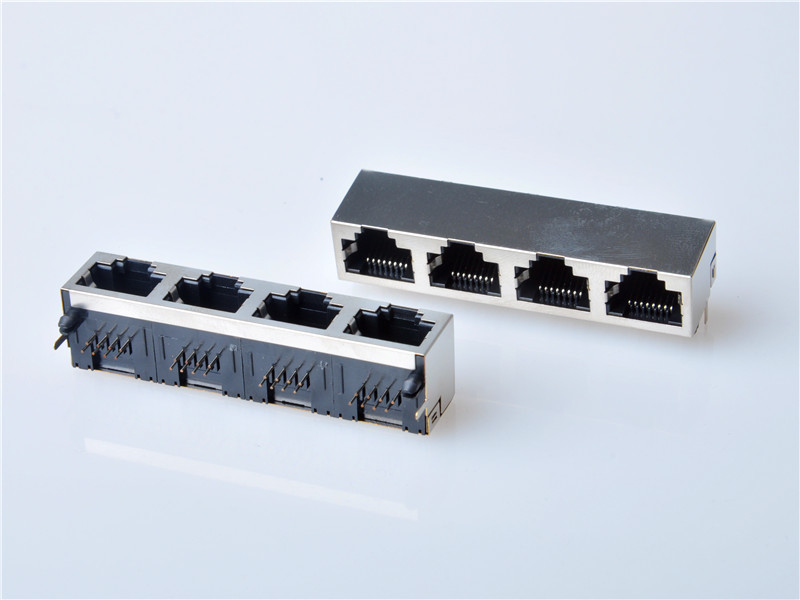

RJ45 connectors play a crucial role in modern networking setups.
1. Physical Structure
1-1. Design:
RJ45 connectors are small, rectangular - shaped components. They are typically made of durable plastic materials. The outer casing provides protection to the internal wiring and helps in easy handling.
They have eight pins or conductors, which are arranged in a specific pattern. These pins are used to transmit and receive electrical signals.
1-2. Size and Compatibility:
The standard RJ45 connector is designed to fit into RJ45 ports. Its size is standardized to ensure compatibility with a wide range of networking devices. For example, it can be easily inserted into Ethernet ports on computers, routers, switches, and network printers.
1-3. Functionality
Data Transmission
RJ45 connectors are mainly used for Ethernet networking. They are capable of transmitting high - speed data signals. In a typical Gigabit Ethernet connection, RJ45 connectors can handle data transfer rates of up to 1000 Mbps (megabits per second).
They use a differential signaling technique, where pairs of wires are used to transmit positive and negative versions of the same signal. This helps in reducing interference and improving the integrity of the transmitted data.
2.Network Connectivity
These connectors are essential for establishing wired network connections. Whether it is for connecting a desktop computer to a local area network (LAN) in an office or for setting up a home network, RJ45 connectors are the go - to choice. They allow devices to communicate with each other over a network, enabling functions such as file sharing, Internet access, and network - based applications.


3. Types and Variations
Straight - through and Crossover
There are two main types of RJ45 cables with different connector configurations. Straight - through cables are used to connect different types of devices, such as a computer to a router or a switch. The pin - out on both ends of the cable is the same.
Crossover cables, on the other hand, are used to connect similar devices, like a computer to another computer or a switch to another switch. The pin - out on the two ends of the cable is different, allowing for the proper exchange of data signals between similar devices.
3-1.Shielded and Unshielded
RJ45 connectors can be part of either shielded or unshielded cables. Unshielded RJ45 connectors are commonly used in normal office and home networking environments. They are cost - effective and suitable for most standard networking applications.
Shielded RJ45 connectors are used in environments where there is a higher risk of electromagnetic interference (EMI). For example, in industrial settings or in areas with a lot of electrical equipment, shielded connectors can help protect the data signals from interference, ensuring more reliable network connections.
In conclusion, RJ45 connectors are an integral part of modern networking infrastructure. Their reliable design, high - speed data transmission capabilities, and wide compatibility make them indispensable for establishing wired network connections in various settings, from homes to large corporate offices.


Service Hot Line
Mobile:+86-180-0286-9136
E-mail:sales@dghecon.com
Website:www.dghecon.com
Address: 5th Floor, Building 1, No. 256, Shuixin Road, Dalang Town, Dongguan City, Guangdong Province